The Micciancio-Voulgaris Algorithm for CVP
We review algorithms presented in the paper:
A Deterministic Single Exponential Time Algorithm for Most Lattice Problems based on Voronoi Cell Computations https://cseweb.ucsd.edu/~pvoulgar/files/voronoi_full.pdf
Three components:
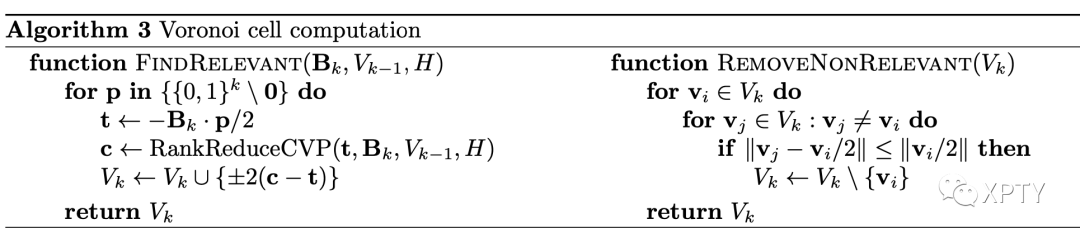
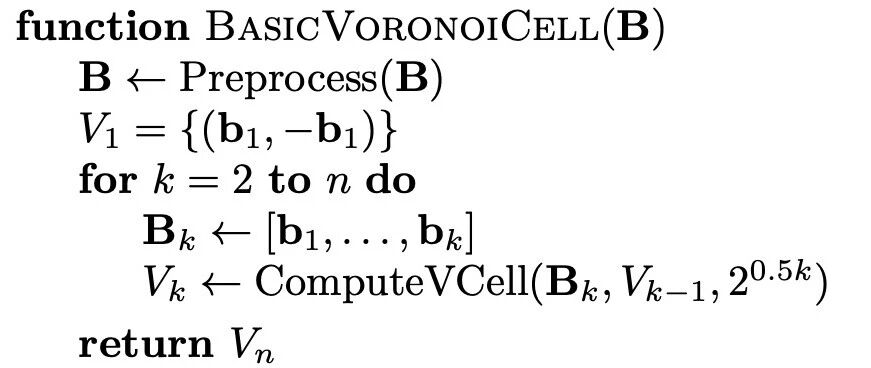
An -time algorithm to solve the *closest vector problem with preprocessing * where the output of the preprocessing function is the Voronoi cell of the input lattice, described as the intersection of half-spaces. A rank reduction procedure that solves CVP on a -rank lattice with calls to a CVP oracle for where an LLL reduced basis for A procedure for computing the Voronoi cell of a lattice by calls to a CVP oracle for and polynomial time computations.
Voronoi cells
The (open) Voronoi cell of a lattice is the set
of all points that are closer to the origin than to any other lattice point. The closed Voronoi cell as the topological closure of . The Voronoi cell of a lattice point is defined similarly, and equals . For any (lattice) point define the half-space
Clearly, is the intersection of for all The minimal set of lattice vectors such that is called the set of Voronoi relevant vectors.
CVP with preprocessing (CVPP)
An algorithm that on input an -rank lattice a list of the Voronoi relevant vectors of and a target vector computes a lattice point closest to in time
a algorithm for the special case where solve the general CVPP problem with polynomially many calls to
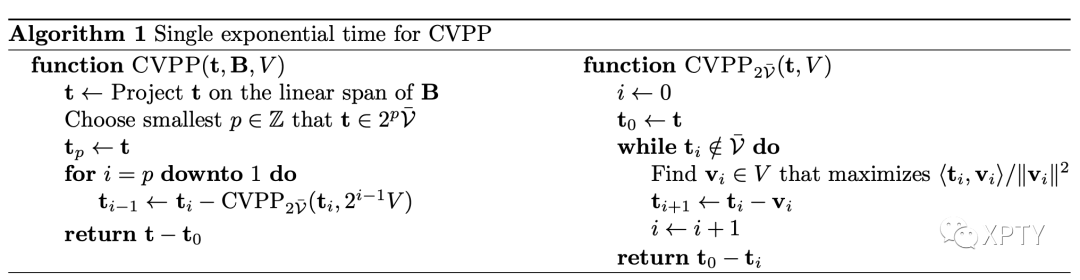
The relation between the Voronoi cell and CVPP is well known. In CVPP, we want to find the lattice point closest to a given target vector . It is easy to see that this is equivalent to finding a lattice vector such that belongs to the (closed) Voronoi cell of the lattice. In other words, CVP can be equivalently formulated as the problem of finding a point in the set .
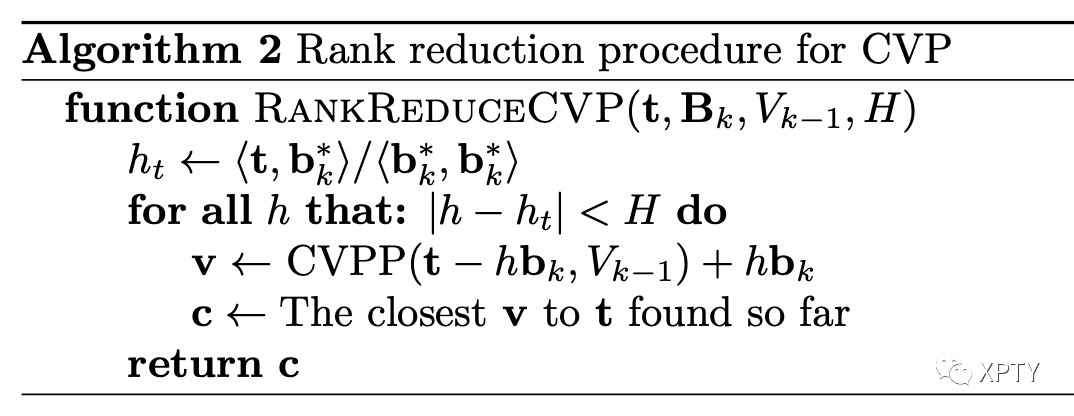
Rank reduction
A procedure that given a basis for a -rank lattice and an integer such that solves a CVP instance on with calls to CVP on the -rank sub-lattice
is the covering radius of and the component of orthogonal to .
A polynomial time preprocessing step that outputs a basis for the input lattice such that, the ratio is bounded by for every This can be achieved by simply running the LLL algorithm. The actual rank reduction procedure that given an integer such that solves a CVP instance on with calls to on .
Combining the two steps gives a reduction from a CVP in to s in
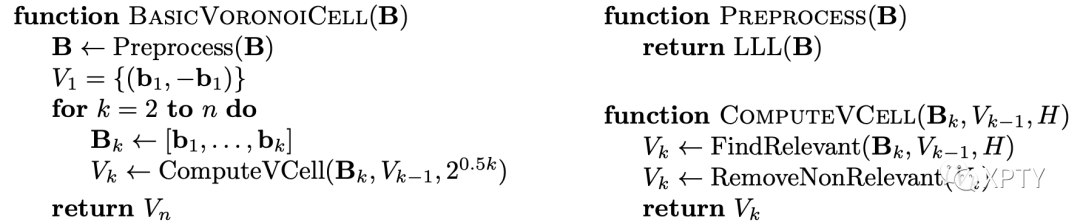
Computing the Voronoi cell
This component computes the relevant vectors of a lattice by calls to all for the same lattice, plus polynomial time computations. Computes the relevant vectors in two steps:
First it runs the procedure that, given a lattice outputs a list of size that contains all the relevant vectors, with the help of CVP queries. Then it feeds the output list to the procedure. discards the non-relevant points from a list of lattice points that contains all the relevant vectors in time Notice that therefore this step takes time.