
Security of Schnorr Signature in AGM
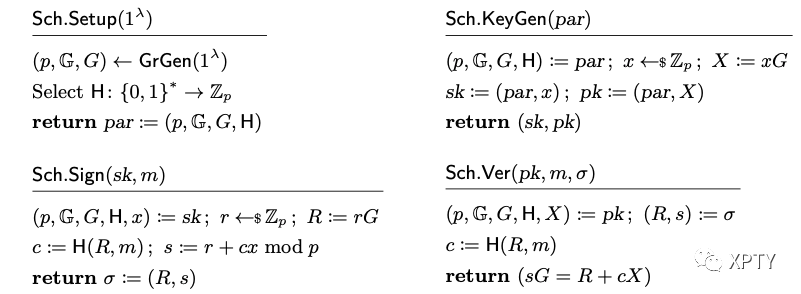
The Schnorr Signature Scheme
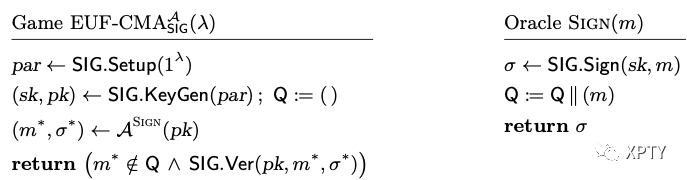
EUF-CMA Game
Security of Schnorr Signatures in the AGM
Theorem: Let be a group generator. Let be an algebraic adversary against the -CMA security of the Schnorr signature scheme Sch[GrGen] running in time at most and making at most signature queries and queries to the random oracle. Then there exists an algorithm solving the problem w.r.t. GrGen, running in time at most such that
: Let be an algebraic adversary in EUF-CMA that makes at most signature queries and RO queries. We proceed by a sequence of games specified in Figure below:
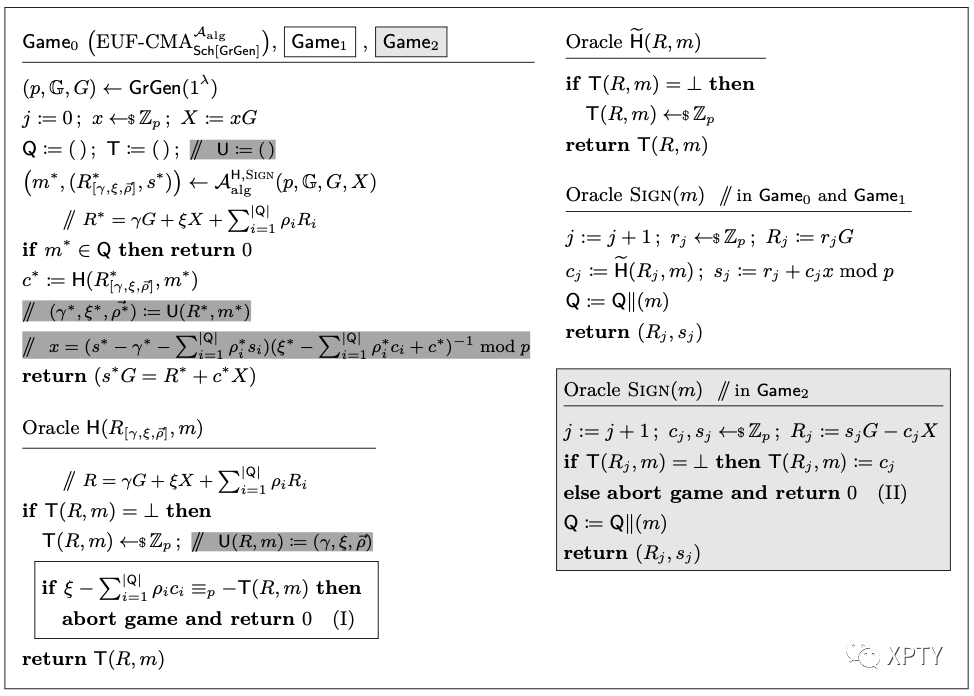
The dark-gray comments show how solves DL.
Game0
The first game is EUF-CMA for the Schnorr signature scheme with a random oracle . The game maintains a list of queried messages and of values sampled for . Since the adversary is algebraic, it must provide a representation for its forgery such that and similarly for each RO query .
To prepare the change to , we have written the finalization of the game in an equivalent way: it first checks that and then runs , which we have written explicitly.
Also, the game calls rather than but in these two oracles are equivalent.
By definition,
Game1
In , when is called, the game returns 0 in case the freshly drawn random value satisfies .
Clearly, for each call to this happens with probability Since is called at most times by the adversary and once by the game when checking the signature, by the union bound, one has
Game2
In the final game we use the standard method for Schnorr signatures of simulating the SIGN oracle without the secret key by programming the random oracle.
and are identical unless returns 0 in line (II). For each signature query, is uniformly random, and the size of table is at most , hence the game aborts in line (II) with probability at most By summing over the at most signature queries, we have
Reduction to DL
We now construct an adversary solving DL with the same probability as wins .
On input group description and the adversary runs on input and simulates , which can be done without knowledge of . It also uses an auxiliary table that for each query stores the representation of . Assume that the adversary wins by returning and let (which is necessarily defined after the call We argue that necessarily and
First note that as otherwise the game would already have returned Hence can only have been defined either (1) during a call to by the adversary or if it is still undefined when stops, by the game when calling In both cases, this call sets both and and is necessarily satisfied as otherwise the game would have returned 0 at line (I).
Since with and validity of the forgery implies that it follows that and can compute
We thus have
Assuming that scalar multiplications in and assignments in tables and take unit time, the running time of is .