SUBSET-SUM is NP-complete
Given a collection of numbers and a target number . To determine whether the collection contains a subcollection that adds up to .
SUBSET-SUM is in NP
" On input :
Test whether is a collection of numbers that sum to . Test whether contains all the numbers in . If both pass, accept; otherwise, reject."
SUBSET-SUM is NP-complete
Recall that the formulas in 3SAT are in conjunctive normal form (cnf) with three literals per clause.
Let be a Boolean formula with variables and clauses The reduction converts to an instance of the problem wherein the elements of and the number are the rows in the table in figure below expressed in ordinary decimal notation. The rows above the double line are labeled
and constitute the elements of The row below the double line is .
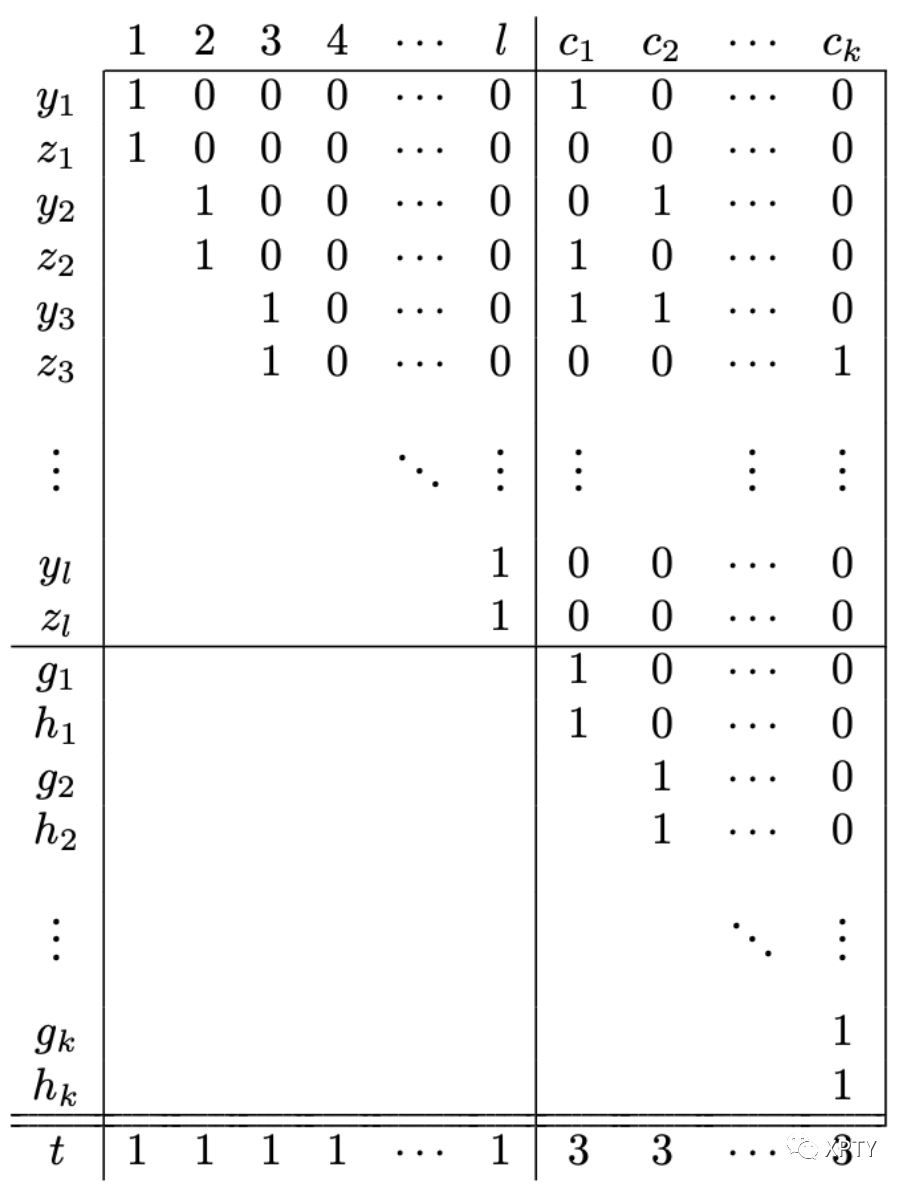
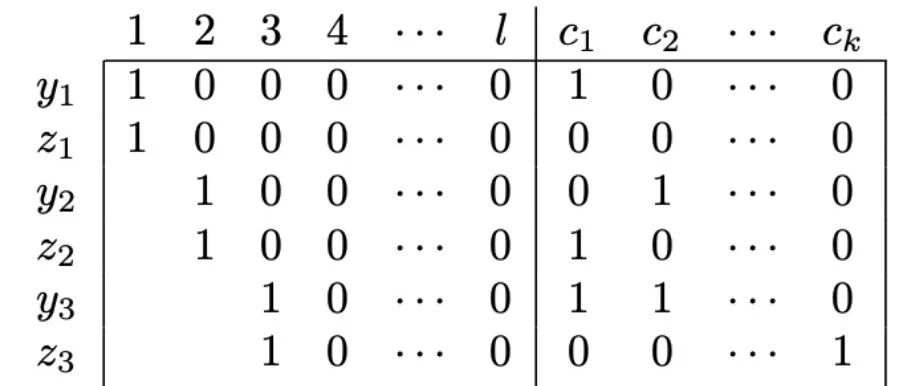
Thus, contains one pair of numbers, for each variable in The decimal representation of these numbers is in two parts, as indicated in the table. The left-hand part comprises a 1 followed by 0s. The right-hand part contains one digit for each clause, where the digit of in column is 1 if clause contains literal , and the digit of in column is 1 if clause contains literal Digits not specified to be 1 are 0 . The table is partially filled in to illustrate sample clauses, and
Additionally, contains one pair of numbers, for each clause These two numbers are equal and consist of a 1 followed by 0s.
Finally, the target number the bottom row of the table, consists of s followed by 3s.
Next, we show why this construction works. We demonstrate that is satisfiable iff some subset of sums to .
Suppose that is satisfiable. We construct a subset of as follows. We select if is assigned TRUE in the satisfying assignment, and if is assigned FALSE. If we add up what we have selected so far, we obtain a 1 in each of the first digits because we have selected either or for each Furthermore, each of the last digits is a number between 1 and 3 because each clause is satisfied and so contains between 1 and 3 true literals. We additionally select enough of the and numbers to bring each of the last digits up to thus hitting the target.
Suppose that a subset of sums to We construct a satisfying assignment to after making several observations. First, all the digits in members of are either 0 or Furthermore, each column in the table describing contains at most five 1 s. Hence a "carry" into the next column never occurs when a subset of is added. To get a 1 in each of the first columns, the subset must have either or for each but not both.
Now we make the satisfying assignment. If the subset contains we assign TRUE; otherwise, we assign it FALSE. This assignment must satisfy because in each of the final columns, the sum is always In column at most 2 can come from and so at least 1 in this column must come from some or in the subset. If it is then appears in and is assigned so is satisfied. If it is then appears in and is assigned FALSE, so is satisfied. Therefore, is satisfied.
Finally, we must be sure that the reduction can be carried out in polynomial time. The table has a size of roughly and each entry can be easily calculated for any So the total time is easy stages.