
NL = coNL
We show that is in and thereby establish that every problem in coNL is also in because is NL-complete. The algorithm that we present for must have an accepting computation whenever the input graph does not contain a path from to .
First, let's tackle an easier problem. Let be the number of nodes in that are reachable from We assume that is provided as an input to and show how to use to solve . Later we show how to compute .
Given and the machine operates as follows. One by one, goes through all the nodes of and nondeterministically guesses whether each one is reachable from Whenever a node is guessed to be reachable, attempts to verify this guess by guessing a path of length or less from to If a computation branch fails to verify this guess, it rejects. In addition, if a branch guesses that is reachable, it rejects. Machine counts the number of nodes that have been verified to be reachable. When a branch has gone through all of G's nodes, it checks that the number of nodes that it verified to be reachable from equals the number of nodes that actually are reachable, and rejects if not. Otherwise, this branch accepts.
In other words, if nondeterministically selects exactly nodes reachable from not including and proves that each is reachable from by guessing the path, knows that the remaining nodes, including are not reachable, so it can accept.
Next, we show how to calculate the number of nodes reachable from We describe a nondeterministic log space procedure whereby at least one computation branch has the correct value for and all other branches reject.
For each from 0 to we define to be the collection of nodes that are at a distance of or less from (i.e., that have a path of length at most from ). So each and contains all nodes that are reachable from Let be the number of nodes in We next describe a procedure that calculates from Repeated application of this procedure yields the desired value of
We calculate from using an idea similar to the one presented earlier. The algorithm goes through all the nodes of determines whether each is a member of and counts the members.
To determine whether a node is in we use an inner loop to go through all the nodes of and guess whether each node is in Each positive guess is verified by guessing the path of length at most from For each node verified to be in the algorithm tests whether is an edge of If it is an edge, is in . Additionally, the number of nodes verified to be in is counted. At the completion of the inner loop, if the total number of nodes verified to be in is not all have not been found, so this computation branch rejects. If the count equals and has not yet been shown to be in we conclude that it isn't in . Then we go on to the next in the outer loop.
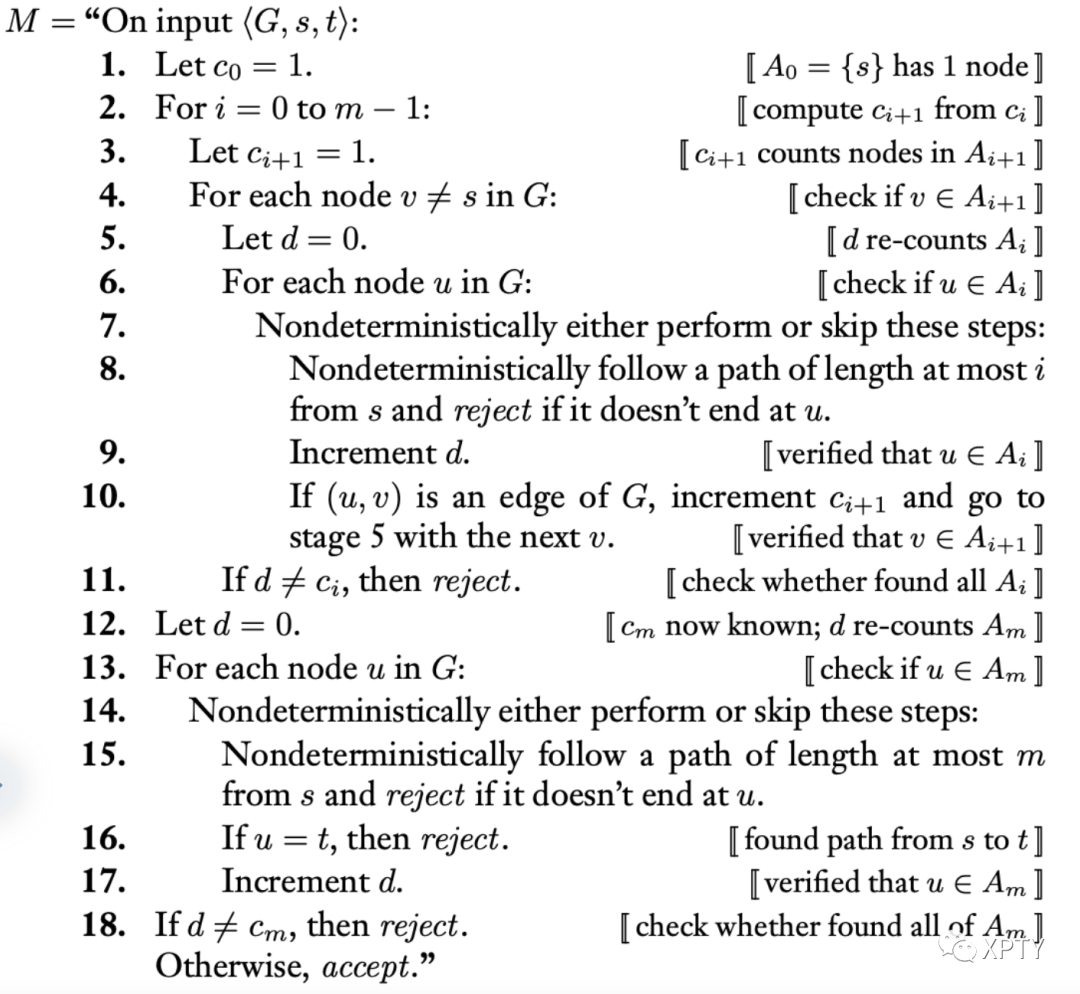
This algorithm only needs to store and a pointer to the head of a path at any given time. Hence it runs in log space.