
Kurt Pan 密码周刊 (9)
Papers
Two-round n-out-of-n and Multi-Signatures and Trapdoor Commitment from Lattices
Construct several lattice-based distributed signing protocols with low round com- plexity following the Fiat–Shamir with Aborts (FSwA) paradigm/ distributed variants of the fast Dilithium-G signature scheme/ using homomorphic commitments/ construction of suitable trapdoor commitment from lattices https://eprint.iacr.org/2020/1110.pdf Subtractive Sets over Cyclotomic Rings: Limits of Schnorr-like Arguments over Lattices
construct Schnorr-like lattice-based proofs of knowledge for the SIS relation/ represents a barrier to practically efficient lattice-based succinct arguments in the Bulletproof framework https://eprint.iacr.org/2021/202.pdf Revisiting Homomorphic Encryption Schemes for Finite Fields
propose an improved variant of BFV where the encryption operation is modified to significantly reduce the noise growth, which makes the BFV noise growth somewhat better than for BGV https://eprint.iacr.org/2021/204.pdf Compact Zero-Knowledge Proofs for Threshold ECDSA with Trustless Setup
propose compact zero-knowledge proofs for threshold ECDSA to lower the communication bandwidth, as well as the computation cost. https://eprint.iacr.org/2021/205.pdf YOSO: You Only Speak Once Secure MPC with Stateless Ephemeral Roles
roles, which are stateless parties that can only send a single message./ describe several techniques for achieving YOSO MPC/ https://eprint.iacr.org/2021/210.pdf Mesh Messaging in Large-scale Protests: Breaking Bridgefy
show that Bridgefy, as analysed, permitted its users to be tracked, offered no authenticity, no effective confidentiality protections and lacked resilience against adversarially crafted messages https://eprint.iacr.org/2021/214.pdf Limbo: Efficient Zero-knowledge MPCitH-based Arguments
introduces a new interactive oracle proof system based on the MPC-in-the-Head paradigm. https://eprint.iacr.org/2021/215.pdf How to Meet Ternary LWE Keys
NTRU-type cryptosystems/a hybrid attack that combines lattice reduction techniques with Odlyzko’s Meet-in-the-Middle approach/improve on this Meet-in-the-Middle approach, using the representation technique developed for subset sum algorithms. https://eprint.iacr.org/2021/216.pdf Verifiable Random Functions with Optimal Tightness
presenting the first VRF with a reduction from the non-interactive qDBDHI assumption to the security of VRF that achieves this optimal loss. https://eprint.iacr.org/2021/217.pdf Snarky Ceremonies
give a security framework for non-interactive zero-knowledge arguments with a ceremony protocol./ revisit the ceremony protocol of Groth’s SNARK [Bowe et al., 2017]. / show that the original construction can be simplified and optimized, and then prove its security in our new framework. https://eprint.iacr.org/2021/219.pdf Quantum-safe HIBE: does it cost a Latte?
provides the first complete C implementation and benchmarking of Latte https://eprint.iacr.org/2021/222.pdf Group Encryption: Full Dynamicity, Message Filtering and Code-Based Instantiation
the formalization of fully dynamic group encryption (FDGE) - a GE system simultaneously supporting dynamic user enrolments and user revocations./ realize the message filtering feature for GE based on a list of t-bit keywords and 2 commonly used policies https://eprint.iacr.org/2021/226.pdf Rate-1 Key-Dependent Message Security via Reusable Homomorphic Extractor against Correlated-Source Attacks
present general methods to construct information rate-1 PKE that is KDM(n) -secure with respect to blockaffine functions for any unbounded polynomial n. https://eprint.iacr.org/2021/227.pdf On Publicly-Accountable Zero-Knowledge and Small Shuffle Arguments
show how to transform such three-move arguments into publicly-accountable ones which allow the verifier to convince third parties of detected misbehavior by a cheating prover/construct interactive, public-coin, zero-knowledge arguments with noticeable soundness error for proving that a target vector of commitments is a pseudorandom permutation of a source vector. Our arguments do not rely on any trusted setup and only require the existence of collision-resistant hash functions. The communication complexity of our arguments is independent of the length of the shuffled vector. https://eprint.iacr.org/2021/228.pdf LL-ORAM: A Forward and Backward Private Oblivious RAM
FP/BP-ORAM definitions and present LL-ORAM, the first FP/BP-ORAM that achieves near-zero client storage, single-round-trip read/write, worst-case sublinear search time, and an extremely simple implementation https://eprint.iacr.org/2021/231.pdf Fast Factoring Integers by SVP Algorithms
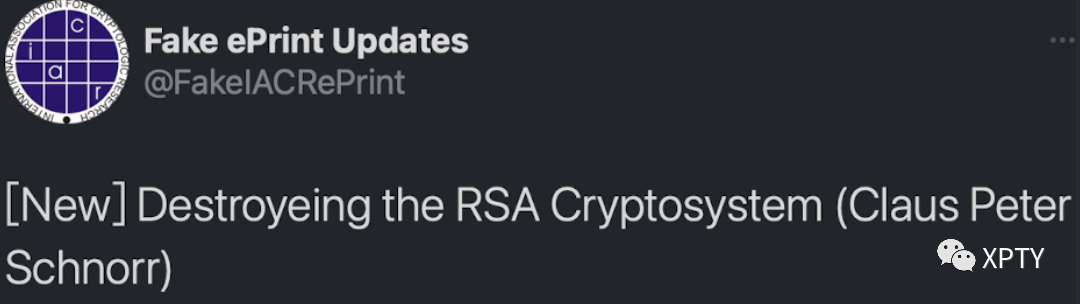
This destroys the RSA cryptosystem. https://eprint.iacr.org/2021/232.pdf Public-Coin Statistical Zero-Knowledge Batch Verification against Malicious Verifiers
constructing a public-coin maliciousverifier SZK protocol for batch verification of NISZK https://eprint.iacr.org/2021/233.pdf New Public-Key Crypto-System EHT
an LWE problem with a hidden trapdoor is introduced https://eprint.iacr.org/2021/234.pdf More Efficient Digital Signatures with Tight Multi-User Security
construct the currently most efficient signature schemes with tight multi-user security against adaptive corruptions/ propose a new variant of the generic construction of signatures from sequential OR-proofs https://eprint.iacr.org/2021/235.pdf Post-quantum Security of OAEP Transform
show that OAEP transform is indistinguishable under chosen ciphertext attack in the quantum random oracle model if the underlying trapdoor permutation is quantum partial-domain one-way https://eprint.iacr.org/2021/237.pdf The Relationship Between Idealized Models Under Computationally Bounded Adversaries
showing that the ROM is a strictly “milder” heuristic than the GGM, which in turn is strictly milder than the GBM https://eprint.iacr.org/2021/240.pdf On the ideal shortest vector problem over random rational primes
report a surprising connection between the complexity of the shortest vector problem (SVP) of prime ideals in number fields and their decomposition groups. https://eprint.iacr.org/2021/245.pdf Master-Key KDM-Secure ABE via Predicate Encoding
https://eprint.iacr.org/2021/246.pdf Generic Compiler for Publicly Verifiable Covert Multi-Party Computation
https://eprint.iacr.org/2021/251.pdf Cryptanalysis of the quantum public-key cryptosystem OTU under heuristics from Szemer´edi-type statements
https://eprint.iacr.org/2021/257.pdf A Geometric Approach to Homomorphic Secret Sharing
propose a simple compiler for HSS evaluating multivariate polynomials https://eprint.iacr.org/2021/260.pdf The Rise of Paillier: Homomorphic Secret Sharing and Public-Key Silent OT
https://eprint.iacr.org/2021/262.pdf Compressed Linear Aggregate Signatures Based on Module Lattices
can be seen as an aggregated variant of Dilithium. https://eprint.iacr.org/2021/263.pdf On the Hardness of Module-LWE with Binary Secret
prove that the Module Learning With Errors (M-LWE) problem with binary secrets and rank d is at least as hard as the standard version of M-LWE with uniform secret and rank k https://eprint.iacr.org/2021/265.pdf
Posts & Videos
| Title | Link |
|---|---|
| Did Schnorr destroy RSA? Show me the factors. | https://sweis.medium.com/did-schnorr-destroy-rsa-show-me-the-factors-dcb1bb980ab0 |
Resources & Events
SchnorrGate - Testing Schnorr's factoring claim in Sage
https://github.com/lducas/SchnorrGate RSA is alive- try to implement the algorithm that claims to break RSA so we shall see
https://github.com/Ariana1729/RSA-is-alive The halo2 Book: https://zcash.github.io/halo2/index.html
FC21
https://fc21.ifca.ai/program.php
Keynote: Signature and Commitment by Whitfield Diffie A formal model of Algorand smart contracts Everything You Ever Wanted to Know About Bitcoin Mixers (But Were Afraid to Ask) Rabbit: Efficient Comparison for Secure Multi-Party Computation Zero-Knowledge Proofs for Set Membership: Efficient, Succinct, Modular Generic Plaintext Equality and Inequality Proofs Somewhere Statistically Binding Commitment Schemes with Applications Another Look at Extraction and Randomization of Groth's zk-SNARK BooLigero: Improved Sublinear Zero Knowledge Proofs for Boolean Circuits Mining for Privacy: How to Bootstrap a Snarky Blockchain SoK: Communication Across Distributed Ledgers Post-Quantum Adaptor Signature for Privacy-Preserving Off-Chain Payments High-Threshold AVSS with Optimal Communication Complexity Fine-Grained Forward Secrecy: Allow-List/Deny-List Encryption and Applications Faster Homomorphic Encryption over GPGPUs via hierarchical DGT Multi-instance Publicly Verifiable Time-lock Puzzle and its Applications Practical Post-Quantum Few-Time Verifiable Random Function with Applications to Algorand
往期周刊回顾:
为了方便电脑用户,以及更开放的互联网访问,周刊内容会同步发布在Gitbook。
点击【阅读原文】👇可访问