
Forking Lemma
Lemma 1: The Splitting Lemma
Let such that . For any define
then the following statements hold:
.
: Assume that Then
This implies a contradiction, hence the result 1.
Statement 2 is a straightforward consequence of the definition.
We finally turn to the last assertion, using Bayes' law:
No-Message Attacks
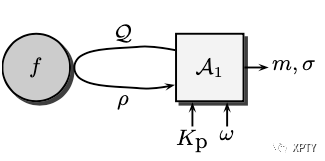
Lemma 2: The Forking Lemma
Assume that, within the time bound produces, with probability valid signature . Then, within time and with probability replay of this machine outputs two valid signatures and such that
:
We start with a no-message attacker which is a probabilistic polynomial time Turing machine with random tape During the attack, this machine asks a polynomial number of questions to the random oracle We may assume that these questions are distinct: for instance, can store questions and answers in a table.
Let be the distinct questions and let be the list of the answers of It is clear that a random choice of exactly corresponds to a random choice of Then, for a random choice of with probability outputs a valid signature Since is a random oracle, it is easy to see that the probability for to be equal to is less than unless it has been asked during the attack. ( is the security parameter and outputs of are of size ) So, it is likely that the question is actually asked during a successful attack.
Accordingly, we define to be the index of this question: (we let if the question is never asked). We then define the sets
We call the set of the successful pairs and we note that the set is a partition of . With those definitions, we find a lower bound for the probability of success, Let be the set consisting of the most likely indices
Lemma 3
The following lemma claims that, in case of success, the index lies in with probability at least .
Lemma 3:
: By definition of the sets This probability is equal to Since the complement of contains fewer than elements, this probability is at least .
We now run the attacker times with random and random Since with probability greater than we get at least one pair in . It is easily seen that this probability is lower bounded by .
We now apply the Splitting-lemma (lemma 1) for each integer we denote by the restriction of to queries of index strictly less than Since there exists a subset of executions such that,
Since all the subsets are disjoint,
We let denote the index corresponding to the successful pair. With probability at least and
Consequently, with probability greater than the attacks have provided a successful pair with and
Furthermore, if we replay the attack, with fixed but randomly chosen oracle such that we know that Then
where and We thus replay the attack times with a new random oracle such that With probability greater than we get another success.
Finally, after less than repetitions of the attack, with probability greater than we have obtained two valid signatures and with and distinct challenges
Adaptively Chosen-Message Attacks
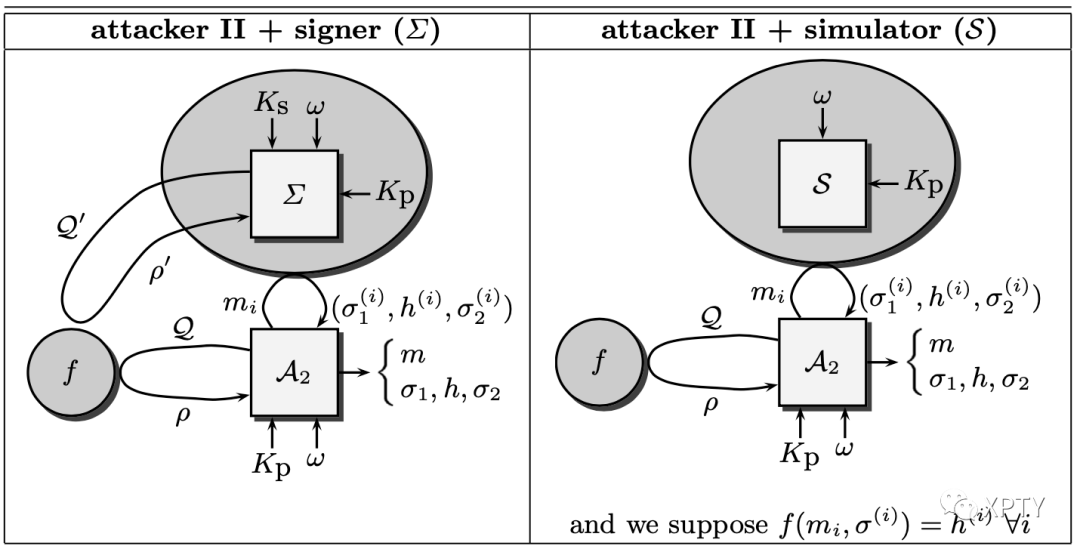
Lemma 4 : The Forking Lemma
Assume that, within a time bound produces, with probability a valid signature is the number of queries that can ask to the signer. If the triples can be simulated without knowing the secret key, with an indistinguishable distribution probability, then, a replay of the attacker where interactions with the signer are simulated, outputs two valid signatures and such that within time and with probability
: As in the previous proof, we let denote the distinct queries to the random oracle, the respective answers, and the queries (possibly all the same) to the signing oracle.
Using the simulator, we can simulate the answers of the signer without knowledge of the secret key. For a message the simulator answers a triple Then, the attacker assumes that and stores it.
The previous proof can be exactly mimicked, except for the problem added by the simulations: there is some risk of "collisions" of queries, or supposed queries, to the random oracle. Recall that in the definition of generic digital signature schemes, we made the assumption that the probability for a "commitment" to be output by the signing oracle is less than Then, two kinds of collisions can appear:
A pair that the simulator outputs also appears in the list of questions asked to the random oracle by the attacker (some question ). The probability of such an event is less than . A pair that the simulator outputs is exactly similar to another pair produced by this simulator (some question The probability of such an event is less than .
Altogether, the probability of collisions is less than Therefore,
This is clearly greater than We can then apply the previous Forking Lemma (lemma 2). Such a replay succeeds with probability within time