Compressed Sigma-protocol Theory
We review the pivotal protocol in the paper [AC20] Thomas Attema and Ronald Cramer. Compressed sigma-protocol theory and practical application to plug & play secure algorithmics. In CRYPTO (3), volume 12172 of Lecture Notes in Computer Science, pages 513–543. Springer, 2020.
Reconciling Bulletproofs with -Protocol Theory: strengthening of -protocol theory, rather than replacement. The natural key is linearization.
First,the pivotal protocol repurposes BPs as a blackbox compression mechanism for standard -Protocols handling ZK proofs of general linear relations (on compactly committed secret vectors) Second, reducing the case of general nonlinear relations to blackbox applications of the pivot via a novel variation on arithmetic secret sharing based techniques for Σ-Protocols (Cramer et al., ICITS 2012).
[CDP 12] linearization : https://eprint.iacr.org/2011/301.pdf
Outline:
A. Pivotal Σ-Protocol commitment with "arbitrary linear form openings"
B. Compressing the Pivot
C. Compactifying a Vector of Commitments
D. Plug-and-Play Secure Algorithmics from Compressed Pivot
Definition (Pedersen Vector Commitment [Ped91]).
Let be an Abelian group of prime order , then Pedersen vector commitments are defined by the following setup and commitment phase.
Setup:
Commit:
and for any and
To partially open a commitment to a linear form
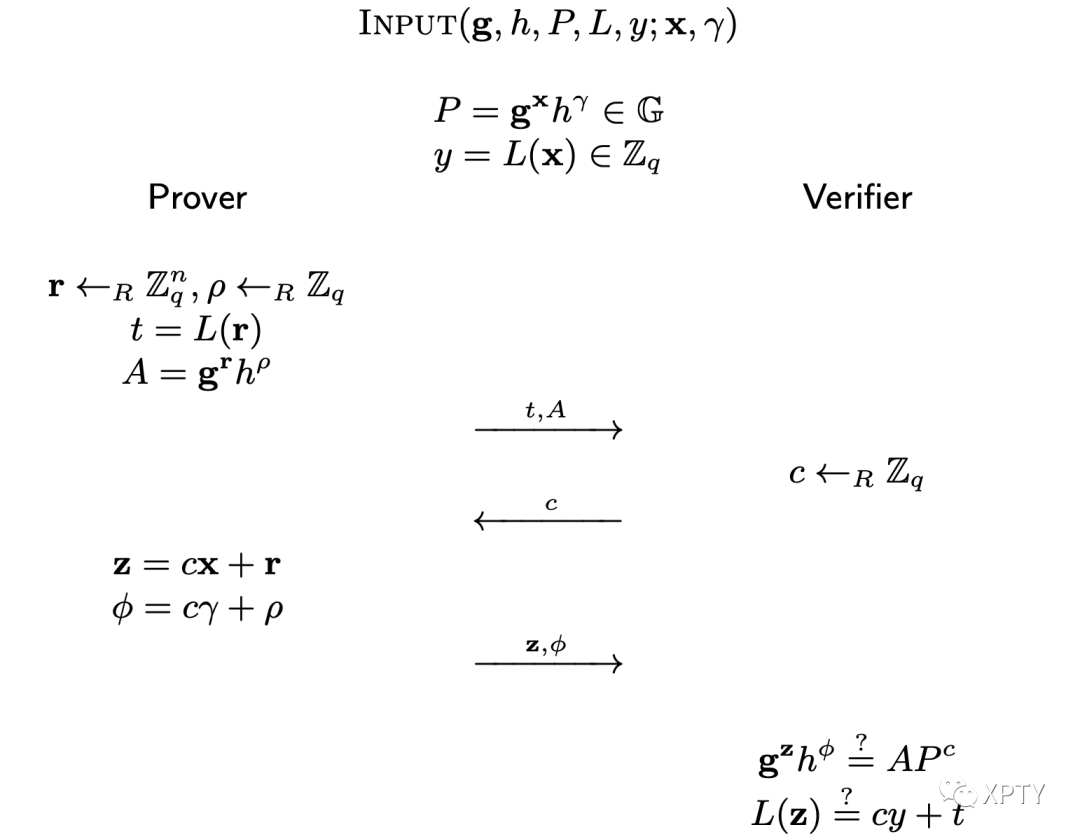
means that the prover wishes to reveal together with a proof of validity without revealing any additional information on x. Achieving this functionality amounts for the prover to send the opening along with a ZKPoK for the relation
Protocol -protocol for relation -protocol to prove correctness of a linear form evaluation.
At the heart of Bulletproofs is an interactive proof of knowledge between a Prover and Verifier showing that a Pedersen commitment to a vector of large length satisfies a multivariate polynomial equation of degree 2, defined with an inner product. We refer to this PoK by BP, with logarithmic communication complexity for the following inner product relation,
to incorporate the linear form into the Pedersen vector commitment
where and for all .
where, and for a random challenge sampled by the verifier.
Protocol Argument of Knowledge for Reduction from relation to relation .
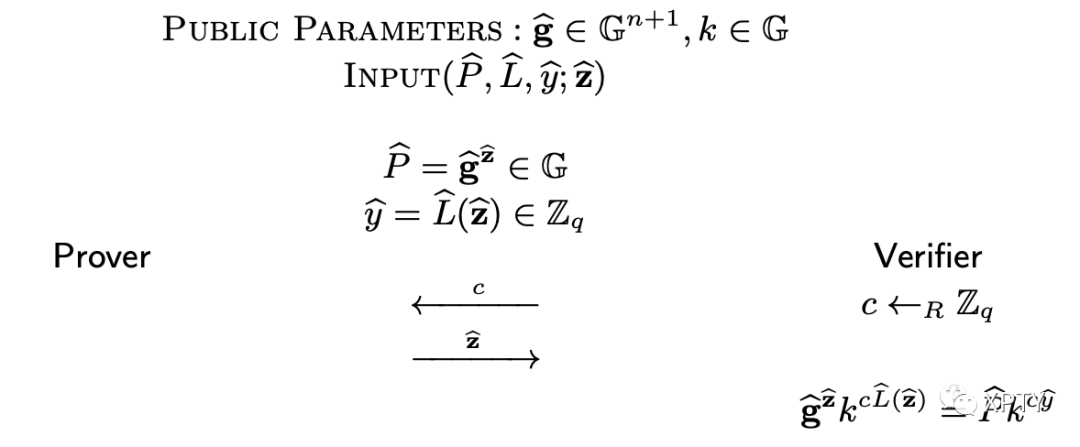
Protocol Compressed Proof of Knowledge for
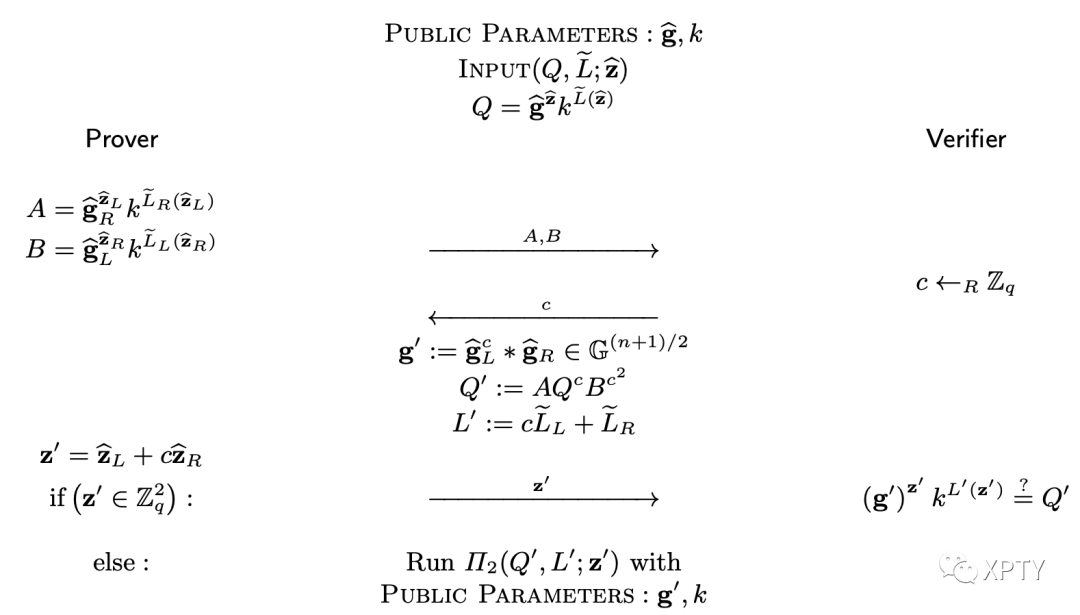
For any even dimension and vector we define as its left half and as its right half. The same notation is used for vectors in For a linear form we define
where are the vectors appended with zeros on the right and left, respectively.
The protocol is recursive and in each iteration the dimension of the witness is halved until its dimension equals 2.
The compressed -protocol for relation is the composition of the previously mentioned protocols, i.e., is a SHVZK argument of knowledge for relation with a logarithmic communication complexity.
Protocol Compressed -protocol for relation
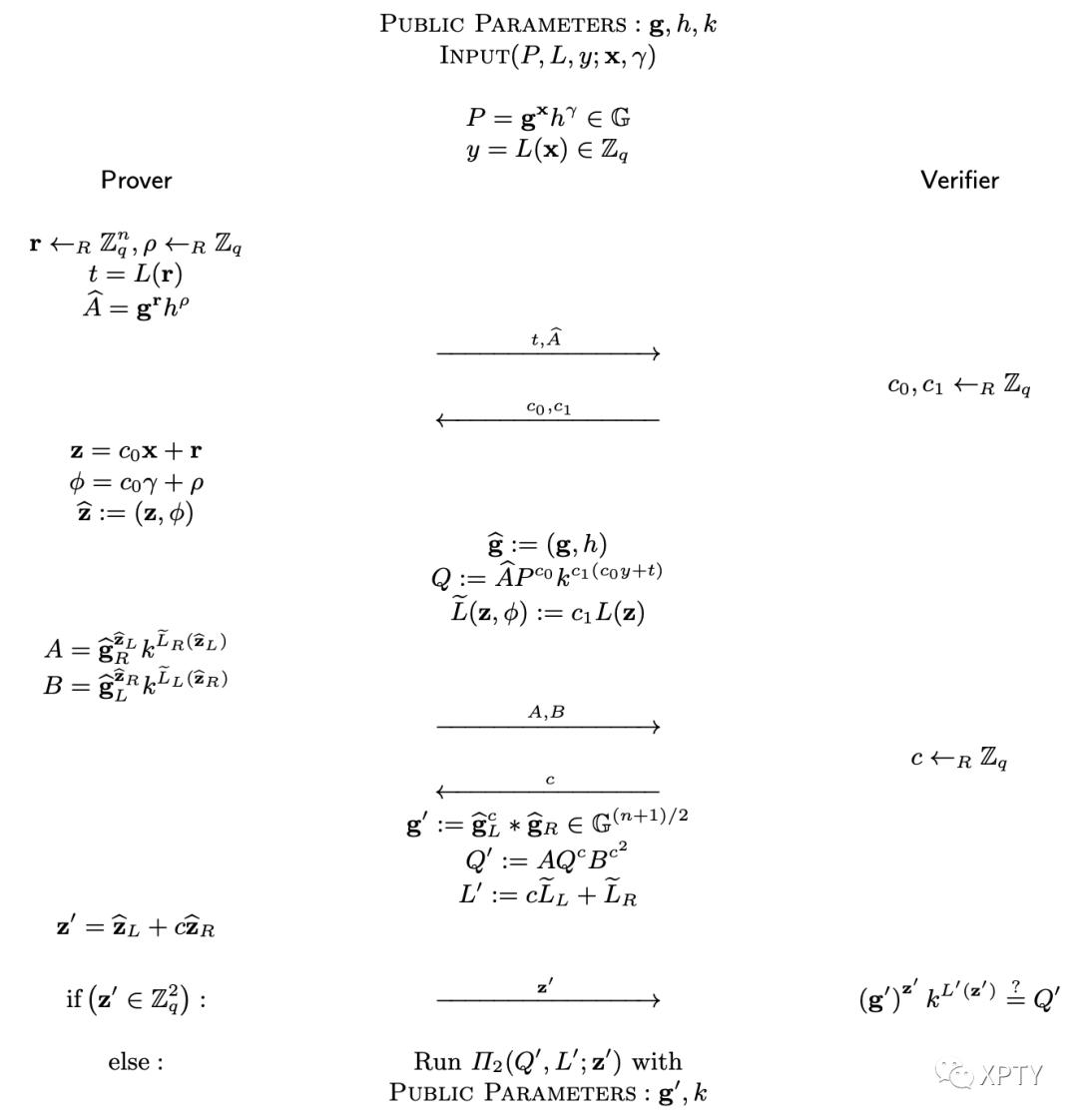
for a compact commitment to a vector and for a (public) linear form we write for the interactive protocol that reveals and nothing else to the verifier.
Protocol Protocol for Opening a Linear Form Evaluated in a Committed Vector
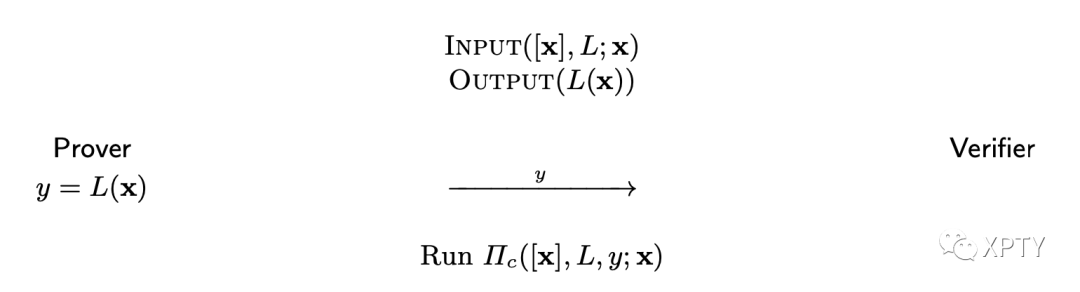
The communication costs of are equal to the cost of the underlying interactive protocol plus 1 field element from to (the output of unless of course the output is known in advance. Similarly, we write for the (amortized) interactive protocol that exclusively reveals for to the verifier.
A polynomial amortization trick allows us to do many nullity checks on the committed vector without a substantial increase in complexity. Consider linear forms and suppose the prover claims that for The verifier then samples uniformly at random and asks the prover to open the linear form i.e., prover and verifier run The opening of equals the evaluation of some polynomial of degree at most If this polynomial is non-zero, it has at most zero's. Hence, implies that for all with probability at least . When is exponential and is polynomial in the security parameter this probability is exponentially close to 1. We write for this protocol.
Protocol Amortized Protocol for Many Nullity Checks at Once
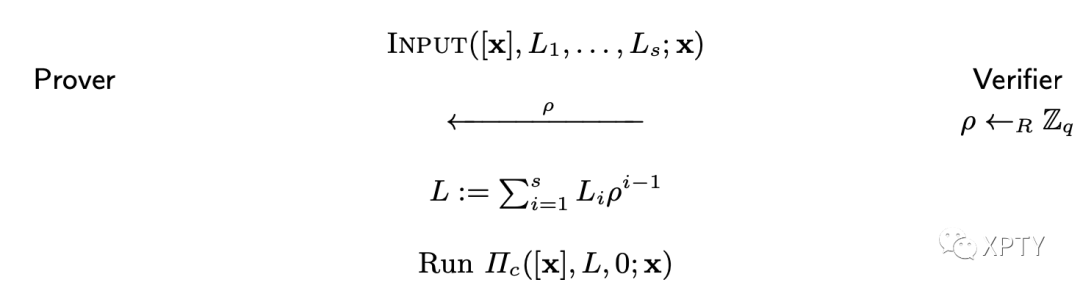
The communication costs are equal to the costs of a single nullity-check plus one additional element from to (the challenge ).
The work of [CDP12] considers homomorphic commitment schemes where the secret committed to is not a vector of large length, but a single element of instead.
Handling Multiplication gates:
The primary result is a -protocol showing the correctness of commitments to multiplication triples with low amortized complexity for large In other words, the protocol verifies the multiplicative relations and the costs per triple are relatively small. They use strongly-multiplicative packed-secret sharing.
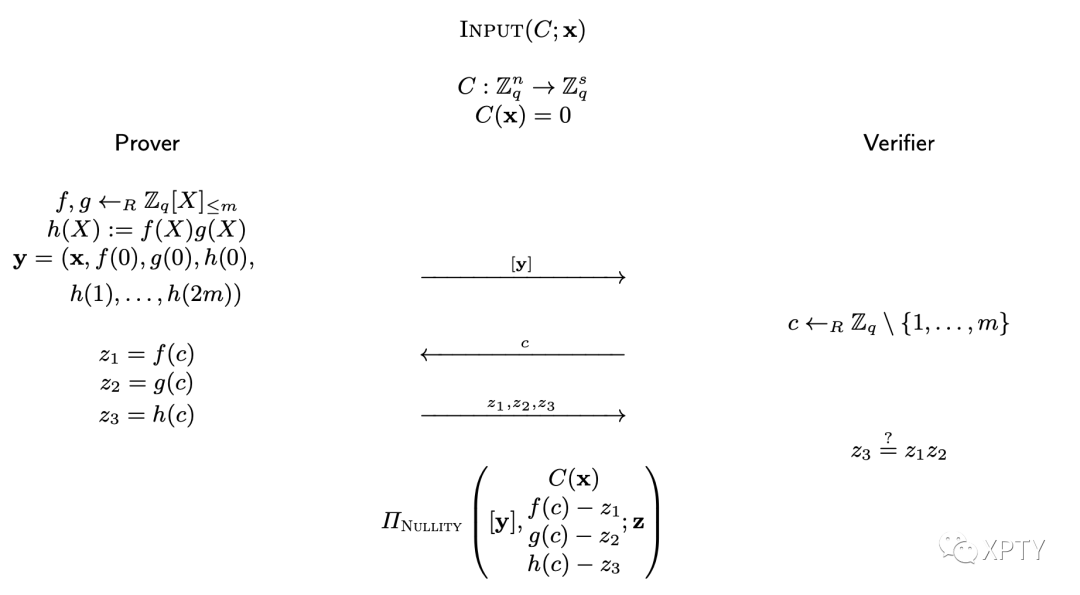
Now we adapt this approach to the circuit satisfiability scenario, where we let be an arbitrary arithmetic circuits with multiplication gates. We use a simple fact about a circuit . Consider the computation graph induced by evaluation at input-vector Write for the resulting outputs of the multiplication gates. For each write for the resulting inputs to the -th multiplication gate. Finally, write for the resulting output of the circuit. Then, for each there are affine forms depending only on such that, for all it holds that and These forms are uniquely determined by the addition and scalar multiplication gates. Similarly, there is an affine function such that, for all it holds that In other words, a given pair can be completed to an accepting computation graph if and only if for and The vector from the above multiplication-triples approach, is now adapted as follows. The prover includes the input vector However, the 's and the 's are omitted from . Otherwise, the vector is unchanged. In particular,
and is a subvector of Subsequently, the prover compactly commits to this adapted vector . By the handle discussed above, the prover needs to convince the verifier that and that for all The and 's are now taken as the evaluation at of the affine functions introduced above. Note that we may capture all these as affine functions evaluated at .
As for checking that is just a nullity check as provided by the pivot. As for (2), the polynomials are still well-defined by the prover's compact commitment to y. Namely,i.e., the randomness underlying its selection, is still included in . As the 's thus defined are affine functions of the prover is still (implicitly) committed to a polynomial of degree such that and and evaluation of in a point is still, by composition of appropriate maps, an affine evaluation at as enabled by the pivot. since is also still included in a similar conclusion is drawn about the 's, and evaluation of the latter. As no changes with respect to were made in we conclude that the required check can be performed in the same way as before.
Proving Nonlinear Relations via Arithmetic Circuits
Circuit satisfiability scenario: a prover shows that it knows an input for which the arithmetic circuit evaluates to 0.
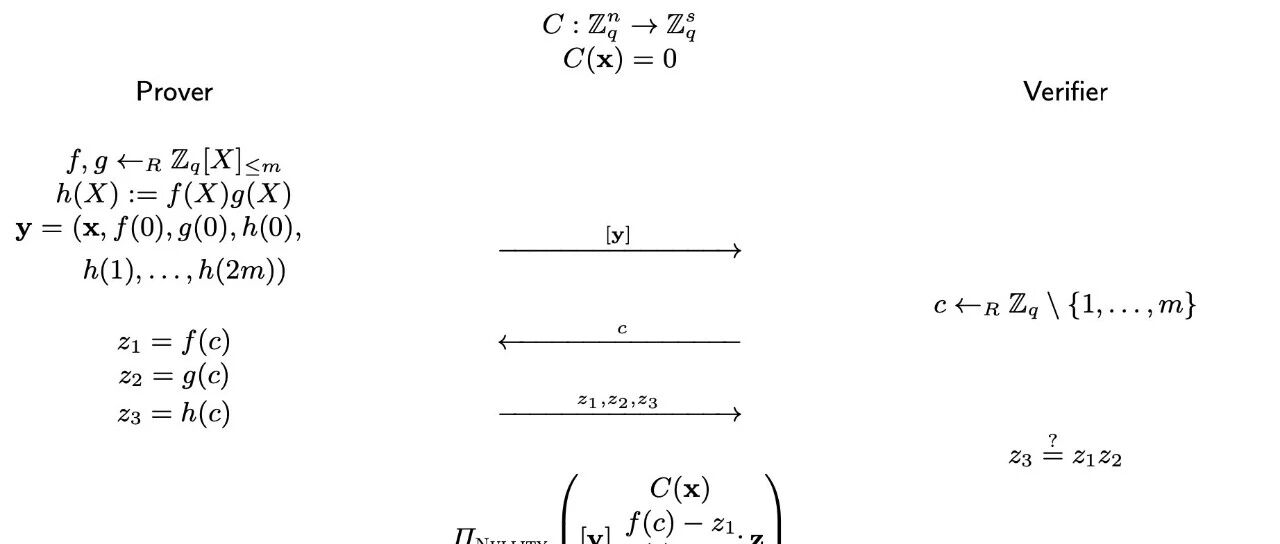
Protocol Circuit Satisfiability Argument for Relation The polynomials and are sampled uniformly at random such that their evaluations in coincide with the left and, respectively, right inputs of the multiplication gates of evaluated at .