
Algebraic Algorithms
Algebraic Security Games and Algorithms
We consider algebraic security games for which we set to a fixed group description where is a cyclic group of prime order generated by
In algebraic security games, we syntactically distinguish between elements of group (written in bold, uppercase letters, e.g., ) and all other elements, which must not depend on any group elements.
As an example of an algebraic security game, consider the Computational Diffie-Hellman game , depicted in Figure 1 (left).
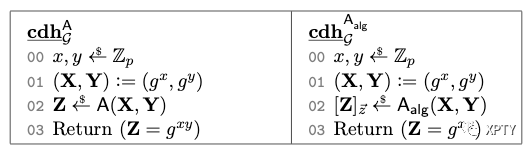
The algebraic adversary additionally returns a representation of such that . Figure 1 (Right)
We now define algebraic algorithms. Intuitively, the only way for an algebraic algorithm to output a new group element is to derive it via group multiplications from known group elements.
Definition (Algebraic algorithm) An algorithm executed in an algebraic game is called algebraic if for all group elements that outputs (i.e., the elements in bold uppercase letters), it additionally provides the representation of relative to all previously received group elements. That is, if is the list of group elements that has received so far (w.l.o.g. ), then must also provide a vector such that . We denote such an output as .
Generic Security Games and Algorithms
Generic algorithms are only allowed to use generic properties of group . Informally, an algorithm is generic if it works regardless of what group it is run in. This is usually modeled by giving an algorithm indirect access to group elements via abstract handles. It is straight-forward to translate all of our algebraic games into games that are syntactically compatible with generic algorithms accessing group elements only via abstract handles.
We say that winning algebraic game is -hard in the generic group model if for every generic algorithm it holds that
We remark that usually in the generic group model one considers group operations (i.e., oracle calls) instead of the running time. In our context it is more convenient to measure the running time instead, assuming every oracle call takes one unit time.
As an important example, consider the algebraic Discrete Logarithm Game in Figure 2 which is -hard in the generic group model [Sho97, Mau05].
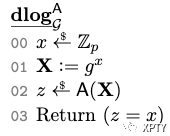
We assume that a generic algorithm additionally provides the representation of relative to all previously received group elements, for all group elements that it outputs. This assumption is w.l.o.g. since a generic algorithm can only obtain new group elements by multiplying two known group elements; hence it always knows a valid representation. This way, every generic algorithm is also an algebraic algorithm.
Furthermore, if is a generic algorithm and is an algebraic algorithm, then is also is an algebraic algorithm. We refer to [Mau05] for more on generic algorithms.
Generic Reductions Between Algebraic Security Games
Let and be two algebraic security games. We write if there exists a generic algorithm (called generic -reduction such that for every algebraic algorithm , algorithm defined as satisfies
Note that we deliberately require reduction to be generic. Hence, if is algebraic, then is algebraic; if is generic, then is generic. If one is only interested in algebraic adversaries, then it suffices to require reduction to be algebraic. But in that case one can no longer infer that is generic in case is generic.
The following lemma explains how statements in the AGM carry over to the GGM.
Lemma: Let and be algebraic security games such that and winning is -hard in the GGM. Then, is -hard in the GGM.
. Let be a generic algorithm playing in game . Then by our premise there exists a generic algorithm such that
Assume then .
Since winning is -hard in the GGM, it follows that
and thus which proves that is -hard in the GGM.